A Groovy Alternative To Java 8 Streams and Collectors
A Better Way To Develop For The Raspberry Pi
Beginners Guide To Linux
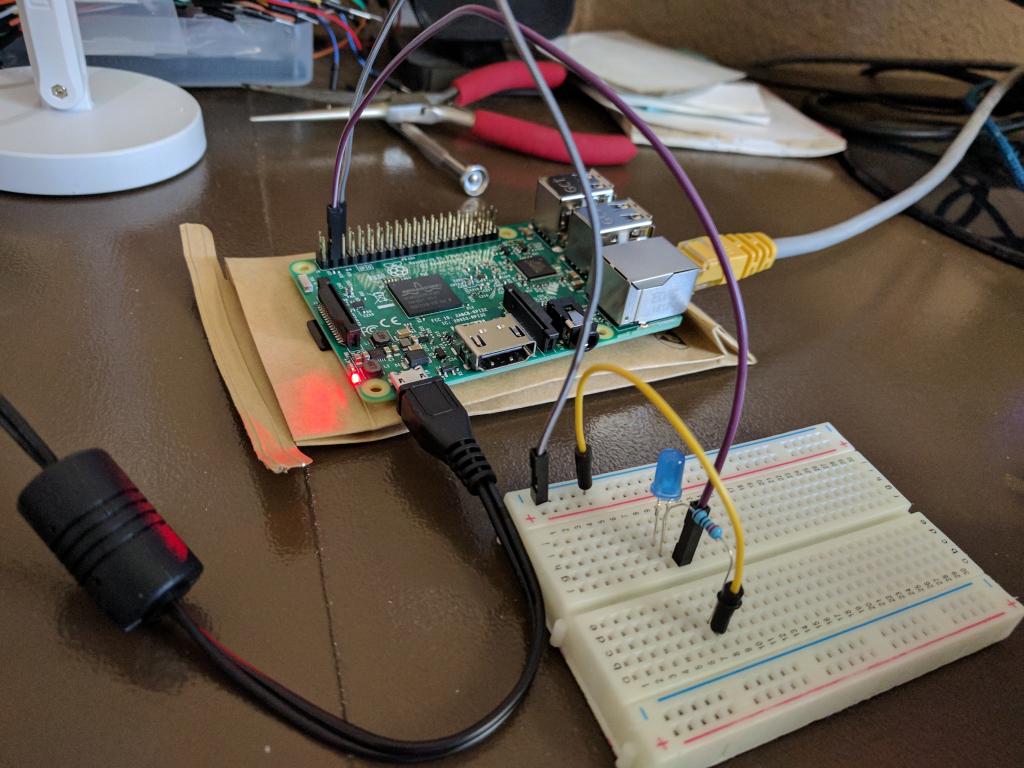
Grails on Raspberry Pi Part 4 - Intro To GPIO
If you’ve missed the first three parts in this series you may want to check them out before proceeding:
Alright, now that you’re all caught up, let’s dig into some of the cool stuff. In this post we’ll look at using Pi4J via a Groovy script to work with the GPIO pins on the Raspberry Pi.
\
Grails on Raspberry Pi Part 3 - Installing Groovy And Grails

The first step in getting working with Grails on the Raspberry Pi is, of course, installing Grails. I’ve been somewhat dreading this post because it’s pretty hard to make installing software interesting, but it’s necessary so we’ll trudge through it and try to have a good time with it. If you’ve never worked with Groovy or Grails before, that’s quite alright. I’ll do my best to make sure that I keep things basic, but at the same time you might want to run through some Groovy or Grails tutorials (there are plenty out there). Also, feel free to ask questions. My goal is to help you get a web site up and running on the Raspberry Pi.
Grails on Raspberry Pi Part 2 - Why Grails?
So why Grails on a Raspberry Pi? It’s a valid question and one that I hope to answer with this post. If you’re not familiar with Grails, perhaps I should first answer - what is Grails?
Grails.org says:
Grails is a powerful web framework, for the Java platform aimed at multiplying developers’ productivity thanks to a Convention-over-Configuration, sensible defaults and opinionated APIs. It integrates smoothly with the JVM, allowing you to be immediately productive whilst providing powerful features, including integrated ORM, Domain-Specific Languages, runtime and compile-time meta-programming and Asynchronous programming.\
Grails on Raspberry Pi - Part 1
In celebration of Pi day (actually, it’s mostly coincidental, but let’s go with it) I wanted to post the first in a series of upcoming posts about using Grails on the Raspberry Pi. The first post is basically an introduction to Raspberry Pi. Forgive my ramblings - I promise to be a bit more concise in future videos, but I felt the intro needed to be a bit thorough.
[youtube id=XzmrAgSjYSU]
My next post will go into installing Grails on the Pi and getting a sample app up and running.
Conference Review - DevNexus 2017
I used to attend a lot of conferences. Back between 2008 and around 2012 I’d go to at least one (if not more) a year. I’ve even spoken at a number of them. I’m far from an expert in presenting at conferences (like my buddy Ray and others) but I was starting to get pretty comfortable with it and even enjoyed speaking when I could. I’m a big fan of conferences. Sometimes a quick intro to a new technology, framework or language is all you need to get rolling and there’s no better way (for me) to get inspired than a live demo from someone who is passionate about a topic. However, the unseen value of conferences has always been (and I suspect always will be) the networking. In fact, I met the team that I now work with in person for the first time at a conference back in 2007 (or was it ‘08 - I’m getting old, forgive my memory lapse).
All that being said, I was anxious to finally get back to attending conferences so in December of last year I submitted a proposal to attend DevNexus in Atlanta. It seemed like the perfect event - only a 2 hour drive from my house and what appeared to be a solid lineup of speakers and sessions. Heck, even my buddy Ray would be speaking there so I had someone to hang out with! \
Hello, World
It’s been quite a while since I’ve blogged. For a while there it seemed like no one really followed blogs anymore, but I decided that it’s a good time to get back in the blogging business.
\
Who is Todd Sharp?
I’m a developer. I guess you could say I’m kinda on my second career. In my first career I worked in various roles at AT&T. When I was a kid I had always wanted to be a programmer, but back in the 80’s and into the early 90’s you pretty much needed to be a pocket-protector wearing Poindexter to make a living writing code so I decided to go to college for Journalism. I started working at AT&T in 1996 while going to school at night. My first job was officially a “summer intern” which required me to do such interesting tasks as “fetch the box of wire from the back of the truck” and “scoop that mud out of the bottom of that manhole with this coffee can”. Paying dues and whatnot. After that first summer I hired on as an Installation Tech. Back in the mid 90’s everyone wanted a “second line” into their home so that they could fire up their 56k modem and surf the “information superhighway”. I spent a few years doing that before the ADSL boom happened. Turned out they needed Engineers to help design the ADSL build out. I got an interview for one of those Engineer jobs (thanks to my father who had been in the Engineering department for years - YAY nepotism!) and was promoted to “Loop Capacity Planner” - a management position. I’d go on to spend about 11 years in various management roles - none of which actually required me to supervise other people. In 2004 I was on the Staff Support team which was charged with supporting 5 states of Planners in the Midwest region. Part of how we supported them was via tooling which was just starting to become web-based. Since I knew how to create Excel macros I was asked to help out the “web team” (one other guy). Just your typical mid-90’s “web master” career path. I didn’t realize it, but that would be the start of my second career and the one that I had wanted since my brother and I “hacked” the code on our Commodore 64 back in like ‘85.
Once I started writing code and learning I was hooked. I’d buy books, read blogs - whatever I could do to learn more about programming. I even started attending conferences - often on my own dime since I wasn’t “technically” a developer at AT&T. I started blogging (on the now defunct cfsilence.com) and even launched a mildly popular service for multimedia presentation sharing called SlideSix. One thing led to another and I met the guys who I now have the pleasure of working with every day. I left AT&T in 2011 and joined the consulting firm Booz Allen Hamilton (most infamously known for being the place Edward Snowden worked for a few short months before he leaked government secrets). It’s been a good ride - I love my job and it’s been a really great place to work. \